Transparency in an HOA doesn’t just come from holding meetings. It comes from creating a clear record of what was actually discussed.
Recently, questions were raised with management regarding how homeowner questions and Board responses are documented in Lake Griffin Estates meeting minutes.
The concern was simple:
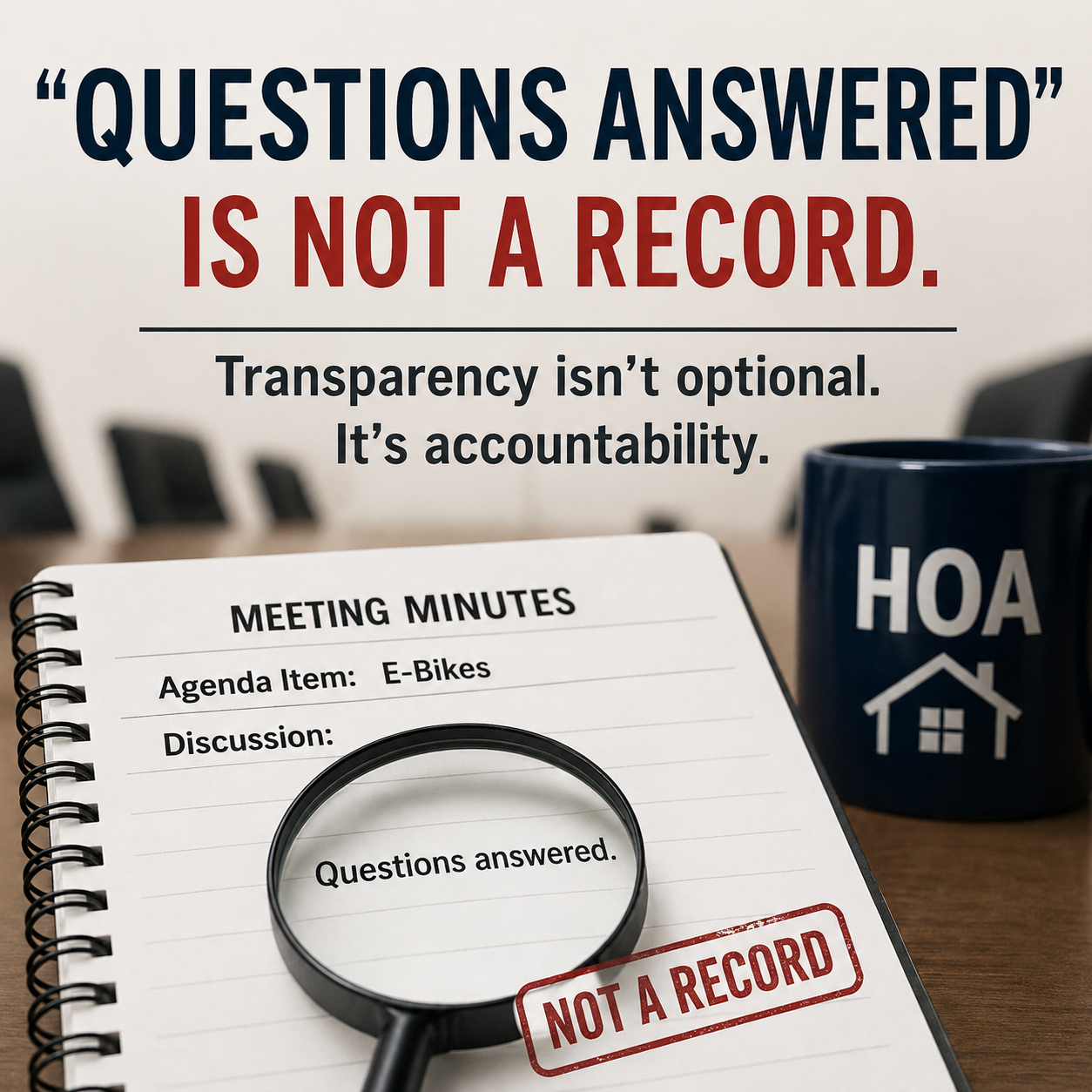
If homeowners ask questions about governance, enforcement, rule interpretation, or Board decisions, why do the minutes often only say “questions answered” or “questions were listened to” without any summary of what was actually discussed?
The Response From Management
Management explained that they were advised to only document what was listed on the agenda and that homeowners are expected to follow Robert’s Rules of Order by asking questions related to agenda items.
They also stated that because homeowners sometimes ask questions outside agenda topics, the minutes simply reflect that questions were heard or answered.
At first glance, that may sound reasonable.
But here’s where the issue starts.
The Problem With “Questions Answered”
When minutes simply state “questions answered,” it creates a blank spot in the historical record.
That may not matter for small topics. But it becomes a major issue when the discussion involves:
- Rule enforcement
- HOA governance
- Board interpretation of community rules
- Resident concerns about policy
- Clarification of enforcement authority
- Community-wide issues that later affect homeowners
When the Board gives clarification or direction during a meeting, that becomes part of how homeowners understand the rules.
If none of that gets documented, homeowners are left with no reliable way to reference what was actually said.
The E-Bike Issue Is a Perfect Example
One of the concerns raised involved the community’s e-bike discussion.
The e-bike topic was reportedly listed directly on the agenda during a prior meeting.
Yet despite being an official agenda item, the meeting minutes reportedly reduce the discussion to a brief statement:
“Motorized vehicle discussion – Stephanie will have email blast sent out to the community reminding them this was in place for safety reasons, children are being supervised while using them and the insurance can drop the association if a claim is made.”
For homeowners who attended the meeting, that summary appears to leave out a significant portion of what actually occurred.
According to those present:
- Questions were asked by homeowners
- Multiple viewpoints were discussed
- Board members participated in the conversation
- Krista reportedly recused herself during part of the discussion, yet the summary in the minutes appears tied only to Stephanie’s statement
- Additional context and concerns were raised beyond the brief summary in the minutes
Yet none of that appears to be reflected in the official record.
That leaves out:
- What homeowners asked
- What concerns were raised
- What the Board said
- Whether guidance or clarification was provided
- What intent existed behind future enforcement
Fast forward to today, and enforcement disputes are now happening around that same topic.
The problem?
There is little or no documented history explaining what was actually discussed during the meeting.
For residents who were present, this creates a disconnect between what occurred publicly and what was preserved in the official minutes.
Many homeowners view this as a transparency issue, especially when later enforcement appears tied to conversations that were never fully documented.
Transparency Matters More Than Ever
Meeting minutes do not have to be transcripts.
Nobody expects word-for-word recordings.
But there is a major difference between concise summaries and documenting nothing meaningful at all.
When an agenda item is publicly discussed, especially one involving rules or enforcement, homeowners should be able to look back and understand:
- What issue was discussed
- What concerns were raised
- What position the Board took
- How future enforcement or interpretation may have been shaped
Without that, minutes stop functioning as a historical record and start functioning as placeholders.
A Fair Question For Homeowners
If an issue is important enough to make the agenda, shouldn’t it also be important enough to be summarized in the official minutes?
Because when the record simply says “questions answered,” it raises a fair concern:
Are homeowners being informed, or are key discussions quietly disappearing from the paper trail?
Why Residents Are Paying Attention
More homeowners are beginning to review minutes closely, compare them against what was actually discussed in meetings, and ask questions about transparency.
And that’s not unreasonable.
HOA governance works best when residents understand how decisions are made, how rules are interpreted, and what was said publicly by leadership.
A clear record protects everyone, including homeowners, Board members, and future Boards.
Because once a discussion disappears from the minutes, it becomes much harder to know what actually happened.
Comments
No comments yet.
Want to join the conversation? Sign in or create an account — comments are for registered members only.